
Learn how to reduce microplastics with practical everyday swaps and a free printable checklist.

This post contains affiliate links and I may receive a small commission if you visit a link and buy something. Purchasing via an affiliate link doesn't cost you any extra, and I only recommend products and services I trust. I may have been sent products featured here as a gift or paid to include them in coverage. Thank you for supporting this blog.
Jump to:
- Download your free microplastics checklist
- What are microplastics?
- What do we know about microplastics and human health?
- How to reduce microplastics in everyday life
- A few additional swaps to consider
- Making the changes work for your budget
- Frequently asked questions
- Small changes are a sensible place to start
- 💬 Comments
Learning how to reduce microplastics can feel like another thing to add to an already long to-do list. Do you need to replace every food container, buy a water filter and rethink your entire wardrobe? Rather than attempting everything at once, start with a few manageable changes: what you heat your lunch in, how you wash your clothes and the items you reach for every day.
The free checklist below is designed to help you work through those changes gradually. There is no need for a perfectly plastic-free home. Choose two or three things that feel achievable, get comfortable with those, then come back to the rest. That is the approach suggested in the printable, too.
Download your free microplastics checklist
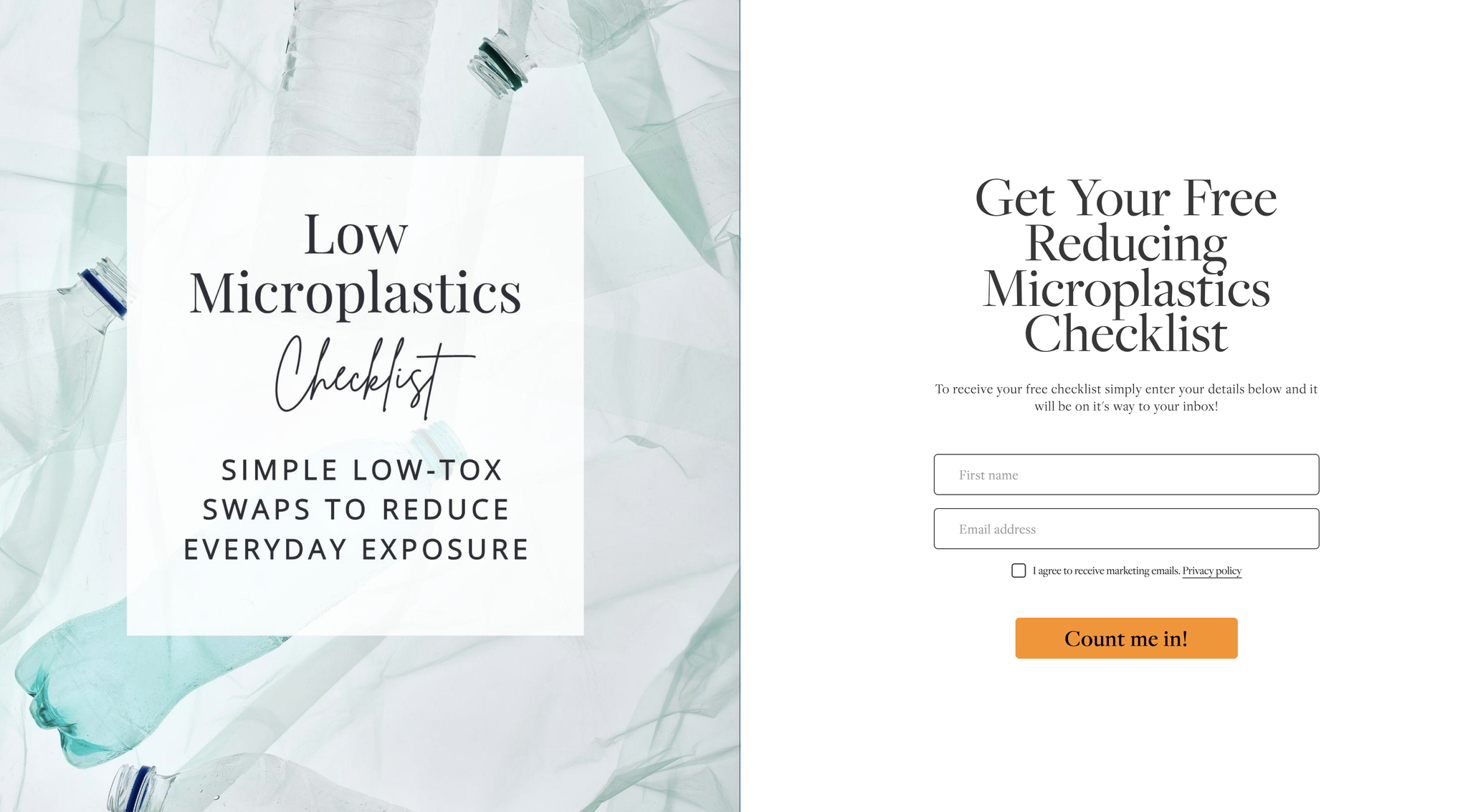
The download includes a short introduction to microplastics and a tick-box checklist covering kitchen and food, cooking, water, laundry and your home. It brings together everyday changes such as using glass containers, avoiding microwaving in plastic, adjusting laundry habits and reducing household dust.
Treat it as a starting point rather than a shopping list. The guidance below adds practical details, explains where the evidence is still developing and helps you make the swaps without overlooking food safety.
What are microplastics?
Microplastics are small plastic particles, generally described as measuring less than five millimetres. Some come from the breakdown of larger plastics: plastic bags, bottles, food packaging and other plastic items can gradually fragment into smaller pieces. Others are manufactured as small particles in the first place. Nanoplastics are smaller still, far beyond what you can see with the naked eye. US EPA
They are not only an issue of visible plastic litter. Synthetic clothing can release plastic microfibres during washing and wear, while marine animals can swallow plastic pieces that then pass through the food chain. Reducing microplastic pollution therefore involves both the products we use and what happens to them afterwards. University of Plymouth
What do we know about microplastics and human health?
Reports of microplastic particles in human blood and breast milk understandably attract attention. However, detecting particles does not, by itself, tell us what health effects they cause or what a particular person's exposure means. U.S. Food and Drug Administration
Early research includes cell and animal studies investigating interactions with the gut, lungs and immune system. These studies help scientists explore potential health risks, but laboratory findings cannot simply be translated into conclusions about everyday exposure. The UK's Committee on the Medical Effects of Air Pollutants also highlights major uncertainties around the effects of breathing in environmental microplastics. Bundesinstitut für Risikobewertung
You may also have seen headlines about heart disease. A 2024 observational study found that patients with microplastics and nanoplastics detected in carotid artery plaque had more subsequent cardiovascular events or deaths than those without detected particles. That finding is important, but an association does not establish that the particles caused those outcomes. PubMed Central (PMC)
The FDA's current position is that available evidence does not demonstrate that the levels detected in foods pose a risk to human health. Important research gaps remain. The aim here is to take reasonable precautions, not to promise that particular swaps will prevent illness. U.S. Food and Drug Administration
How to reduce microplastics in everyday life
The printable divides its suggestions into five areas. You can work through them in order, or begin with whichever part of your routine feels easiest to change.
1. Kitchen and food: start with how you heat and store food
Transferring leftovers into a microwave-safe glass or ceramic dish is a straightforward first step. Research on particular plastic food containers has found that microwave heating can release microplastics and smaller particles into food-simulating liquids. Those experiments do not tell us exactly what happens with every container or meal, but they provide a reason to reduce unnecessary contact between plastic and high temperatures. Nebraska Today
For example, transfer yesterday's curry into a suitable bowl before reheating rather than putting its plastic takeaway tub straight into the microwave. Keep a suitable dish somewhere easy to reach so the change becomes part of your usual routine.
Glass containers are also an option for food storage. Having a plastic lid does not make a glass container pointless: the main body still limits direct contact between the food and plastic. Where practical, keep food below the lid and remove plastic lids before reheating. UC Davis Health
You can also give a clean glass jar a second job storing dry ingredients. Keep reused jars for appropriate storage rather than assuming that an ordinary food jar is suitable for the microwave, oven or sudden temperature changes.
Cool leftovers safely
The checklist suggests letting hot food cool before storing it. This needs an important qualification: do not leave cooked food sitting out for hours while trying to avoid plastic. Low Microplastics Checklist
Divide leftovers into smaller portions in suitable containers so they cool more quickly. UK food-safety guidance advises cooling cooked food and getting it into the fridge within one to two hours. Avoid turning a precaution about plastic into a food-poisoning risk. GOV.UK
Reduce packaging without making eating difficult
The printable also suggests reducing packaged and processed foods. You could start by choosing loose vegetables when practical, taking containers to a refill shop or cooking an extra portion for tomorrow's lunch. Low Microplastics Checklist
Fresh food and less processed foods are not automatically microplastic-free, though. Environmental contamination and inconsistent testing make it difficult to compare the amount of microplastics across foods. A simple "fresh is safe, packaged is unsafe" rule goes beyond what the evidence supports. U.S. Food and Drug Administration
There is no need to make feeding yourself harder. Keep the convenient foods that work for your household, and look for manageable opportunities to use less plastic packaging around them.
2. Cooking: reconsider worn utensils and chopping boards
Plastic chopping boards can shed tiny fragments when knives cut into their surfaces. A small experimental study found particle release from both plastic and wooden boards, although particles from wood are not the same thing as microplastics. The findings support considering non-plastic alternatives, without suggesting that any board is completely particle-free. American Chemical Society
When a board needs replacing, a wooden chopping board is one option. Continue to clean and maintain it properly; the material does not remove the need for good kitchen hygiene.
The cooking section of the checklist also suggests wooden or stainless steel utensils, alongside stainless steel, cast iron or ceramic cookware. Low Microplastics Checklist
Start with what you already own. Put the wooden spoon beside the hob rather than at the back of a drawer. Use your existing stainless steel pan more often. There is no need to buy a matching set before making a change.
Choose food-safe cookware suitable for your hob and follow its care instructions. This is about reducing avoidable plastic contact, not declaring every alternative material harmless in every situation.
3. Water: use a refillable bottle and check filter claims
Both bottled water and tap water have been found to contain microplastics. Plastic water bottles should not be assumed to provide a microplastic-free alternative to the tap. U.S. Food and Drug Administration
Where your local water supply is safe to drink, filling a reusable glass or stainless steel water bottle avoids repeatedly buying disposable plastic bottles. Glass bottles can suit home use, while stainless steel is another option for taking out with you. Home
Safe drinking water comes first. Follow any local water-supply advice rather than avoiding bottled water when it is needed.
Do all water filters remove microplastics?
No filter should be assumed to do this simply because it improves the taste of your water. Different filters target different substances, and a filter designed for one contaminant may not remove another. CDC
Look for independently verified performance for the specific model and replacement cartridge. For example, NSF's certification listings include an explicit "Microplastics Reduction" claim under NSF/ANSI 401. Check for that particular claim rather than relying only on an NSF logo or a general reference to the standard. NSF International
Also check which particle sizes were tested. A claim about microplastic reduction should not be read as a promise to remove every smaller particle or every dissolved chemical.
Heavy metals, microorganisms and microplastics are different concerns, so match any water treatment to what you actually need. Maintain the system and replace cartridges as instructed: neglected filters can allow germs to grow. A filter is not automatically necessary just because you have started thinking about microplastics. CDC
4. Laundry: care for synthetic fabrics rather than replacing everything
Synthetic fabrics can release fibres into wastewater during washing and into the air during wear. That makes laundry relevant to microplastic pollution, but it does not mean you need to throw away your synthetic clothes. University of Plymouth
The checklist suggests washing synthetic fabrics in cold water, air drying when possible and washing less frequently when appropriate. Low Microplastics Checklist
For ordinary laundry, choose a cooler, shorter cycle where the garment's care label and cleaning needs allow. University of Leeds research found that shorter, cooler washes reduced microfibre release in the loads tested. Hygiene requirements still matter, so this is not a blanket instruction to wash every item on cold. University of Leeds
Consider whether something genuinely needs washing after one wear, too. A jumper worn briefly over another layer may not need the same treatment as sweaty exercise clothing.
What about a washing machine filter?
Fibre-catching laundry devices can reduce the amount of material leaving the washing machine, although performance varies. University of Plymouth research comparing several devices found substantial differences between them, so look for independent testing rather than assuming every bag or filter works equally well. University of Plymouth
This is primarily a way to reduce fibres entering wastewater. It is not evidence that fitting a laundry filter will produce a measurable change in the amount of plastic inside your body.
5. Home: tackle dust and ventilate sensibly
Household dust can include tiny plastic particles from synthetic materials in furnishings and other items. Regularly wiping surfaces and cleaning floors is a practical place to start. A damp cloth helps collect dust rather than simply moving it around. UC Davis Health
The home section of the printable recommends opening windows and reducing dust through vacuuming and wiping surfaces. Low Microplastics Checklist
Ventilate when outdoor air quality and conditions make it sensible. Opening windows is not automatically helpful during heavy smoke or poor outdoor air quality: the aim is to bring in cleaner air. The Environmental Protection Agency recommends reducing pollution sources and ventilating with clean outdoor air, with filtration as an additional measure. US EPA
A suitable air purifier with a HEPA filter can reduce airborne particles, but it will not remove every pollutant. Room size, airflow and filter maintenance matter. Start with ordinary cleaning and ventilation rather than feeling that an expensive appliance is essential. US EPA
A few additional swaps to consider
These suggestions go beyond the printable and may be useful once its basic changes feel manageable.
Try loose-leaf tea
Loose-leaf tea in a stainless steel infuser is a reusable alternative that avoids the need for a plastic mesh tea bag.
However, be cautious about dramatic claims that every cup releases a fixed number of billions of particles. Germany's Federal Institute for Risk Assessment has challenged widely repeated findings from a tea-bag study, highlighting problems with sample preparation and particle identification. Different tea bags and testing methods should not be treated as interchangeable. Bundesinstitut für Risikobewertung
The practical choice can stay simple: use loose leaves when convenient, without turning your tea break into another source of worry.
Take a reusable cup to coffee shops
Some disposable paper cups have plastic linings, so "paper" does not necessarily mean there is no plastic in contact with a hot liquid. A reusable cup with a suitable glass, ceramic or stainless steel interior is an alternative to consider. UC Davis Health
Make it easy to remember by keeping your clean cup with the bag you normally take out.
Look at personal care products as well as their packaging
Some microplastics are intentionally manufactured for use in products, including cosmetics. Changing a shampoo bottle or moisturiser pot is therefore not the same as checking what is inside the product. US EPA
Look for clear information about intentionally added solid plastic particles, and ask the manufacturer when the wording is vague. A "natural" or "vegan" label answers a different question; it should not be treated as a complete description of a product's ingredients.
Reuse your shopping bags
Keep reusable grocery bags by the door or in your everyday bag so they are available when you need them. There is no need to buy a new set simply because your existing bags are not made from natural materials.
Reducing the use of single-use plastics addresses the waste that can eventually break into smaller fragments. It is an environmental action, rather than a promise that carrying a different shopping bag will directly change your personal exposure. US EPA
Making the changes work for your budget
Begin with habits before shopping. Use the microwave-safe bowl already in your cupboard, reach for an existing wooden spoon and build a quick surface wipe into your usual cleaning routine.
When something genuinely needs replacing, consider non-plastic alternatives. That might be one food-storage container or one worn chopping board, not an entire kitchen.
It is also reasonable to keep plastic items that serve a useful purpose. Reducing plastic use does not require ignoring cost, accessibility, breakage or the practicalities of family life. Researchers discussing their own households acknowledge that gradual replacement is often more realistic than throwing everything away at once. Home
Frequently asked questions
Can you avoid microplastics completely?
Complete avoidance is not a realistic goal. The checklist itself emphasises reducing exposure rather than achieving perfection. Use it to identify changes within your control, not as a test you have to pass. Low Microplastics Checklist
Is BPA-free plastic also microplastic-free?
No. Bisphenol A, or BPA, is a chemical used in certain plastics and resins. Microplastics are particles. A statement that a product is BPA-free does not establish that it cannot shed plastic particles. NIEHS
BPA is also discussed in research on endocrine disruptors, which interfere with hormonal processes. That is related to, but not interchangeable with, research into the effects of plastic particles themselves. NIEHS
Are PFAS and microplastics the same thing?
No. PFAS stands for per- and polyfluoroalkyl substances, a large group of chemicals. Microplastics describes small plastic particles. These topics can overlap in discussions about products and pollution, but the terms should not be used as synonyms. US EPA
Likewise, a claim about filtering particles does not automatically establish removal of dissolved PFAS or other chemicals. Check the specific treatment claim. CDC
Does boiling water remove microplastics?
A laboratory study found that boiling calcium-containing water helped trap some microplastics and nanoplastics in limescale, which could then be separated out. The effect was stronger in harder water. American Chemical Society
That does not mean boiling destroys plastic or makes every water supply microplastic-free. The water's mineral content and the subsequent removal of the trapped particles matter. It should not replace local drinking-water safety advice. American Chemical Society
Are fresh, organic or vegan foods microplastic-free?
Those labels do not provide a guarantee. Microplastics have been reported in a range of foods, including table salt, and environmental contamination can occur before food is packaged. There is not a dependable "microplastic-free diet" to follow. U.S. Food and Drug Administration
Keep the focus on varied, enjoyable meals rather than trying to eliminate more and more foods.
Should I buy clothing made from natural fibres?
When you need new clothing or bedding, plant-based natural fibres such as cotton, linen and hemp are alternatives to synthetic materials. They also fit a vegan approach without relying on wool or silk. UC Davis Health
Check the complete composition rather than only the main fabric description. For example, an organic cotton garment may still contain a synthetic blend. Replacing a label is not the aim; understanding what you are buying is.
Do I need to throw away plastic toys?
A wholesale clear-out is not necessary. Consider materials when buying replacements, but also think about suitability, condition and how the toy is used. Practical safety considerations should not be pushed aside in the pursuit of a plastic-free home.
Small changes are a sensible place to start
When you are thinking about how to reduce microplastics, choose something you can repeat without much effort. Transfer lunch into a suitable bowl before reheating, adjust a laundry habit or put your reusable bottle where you will remember it.
Individual actions are only part of the answer. Product design, manufacturing decisions and wider protections also matter; the responsibility should not sit entirely with households. Home
Did you find this post on how to reduce microplastics useful? Share it with your friends online and on social media. Also you can save this post by pinning it for later...





Related Posts

Is Red 40 Vegan? What You Should Know About This Food Dye-
Creamy Vegan Chickpea Curry - One-Pot Easy Recipe -
Strawberry and Banana High Protein Vegan Yogurt Recipe




Comments
No Comments